Search
Evaporative air cooling is a simple and energy-efficient method of reducing air temperature. It is widely used in factories, warehouses, workshops, agricultural facilities, and other large spaces where traditional air conditioning may be expensive or impractical. By using the natural process of water evaporation, industrial air coolers can deliver a continuous supply of cooler and fresher air. The basic principle behind evaporative cooling is that water absorbs heat when it changes from liquid into vapor. When warm air comes into contact with water, part of the water evaporates and takes heat energy from the air. As a result, the temperature of the air decreases before it is delivered into the working environment.
An evaporative air cooler typically begins the process by drawing warm outdoor air into the unit. A powerful fan creates negative pressure and pulls air through cooling pads. These pads are continuously supplied with water through a pump and water distribution system, ensuring that their surfaces remain evenly wet during operation. As the warm air passes through the water-saturated cooling pads, evaporation takes place. Heat from the air is used to convert water into vapor, lowering the air temperature. The cooled air is then pushed by the fan into the factory, warehouse, workshop, or other facility.
The cooling pads are among the most important components of the system. Their specially designed structure provides a large surface area for contact between air and water. This increases evaporation efficiency and helps maximize the cooling effect. Clean and properly maintained cooling pads are essential for achieving consistent performance. A water circulation system keeps the cooling pads continuously supplied with water. Water is usually stored in a tank at the bottom of the unit and pumped upward to the distribution system. After flowing through the cooling pads, unused water returns to the tank and is circulated again, helping the system operate efficiently.
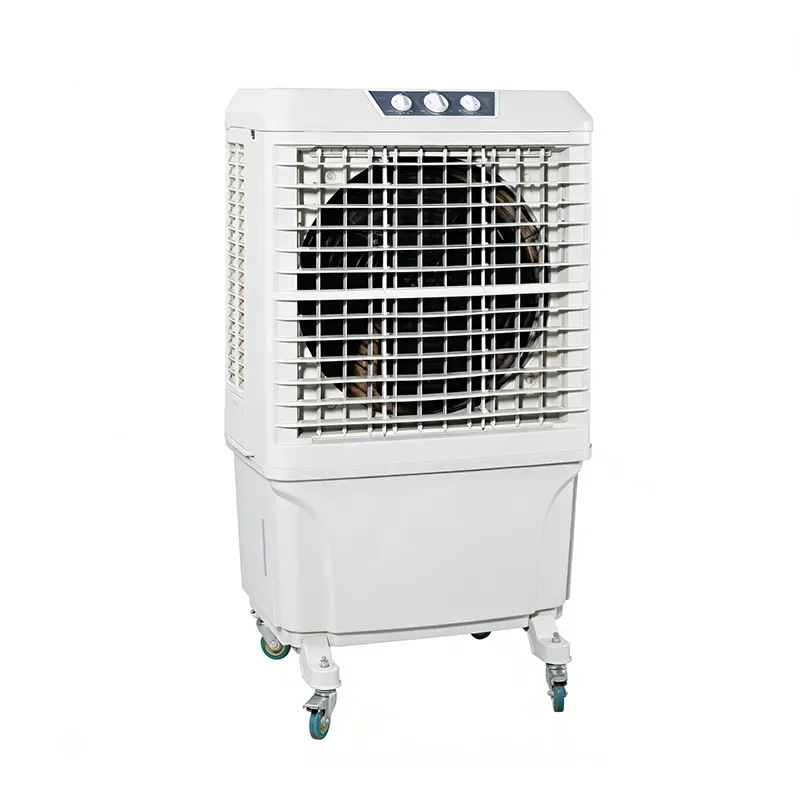
The fan is responsible for delivering the cooled air to the required area. Industrial air coolers are designed to produce high airflow volumes, making them suitable for large spaces. Airflow capacity is commonly measured in cubic meters per hour, or m³/h, and is an important factor when selecting equipment for a particular facility. Unlike traditional air conditioning systems, evaporative air coolers do not depend on compressor-based refrigeration to produce a cooling effect. This simpler operating principle can significantly reduce electricity consumption, particularly when cooling large or semi-open industrial spaces. As a result, evaporative cooling can be an economical solution for many businesses.
Ventilation plays an important role in system performance. Because evaporative cooling adds moisture to the air, the cooled air should be allowed to flow through the facility while warmer air exits through doors, windows, roof vents, or exhaust systems. Proper air exchange helps maintain effective cooling and prevents excessive humidity buildup. Evaporative air coolers generally perform best in dry or relatively low-humidity conditions because dry air has a greater capacity to absorb additional moisture. In very humid environments, the temperature reduction may be more limited. For this reason, local climate and operating conditions should be considered when selecting an evaporative cooling solution.
One of the major advantages of evaporative cooling is its ability to supply fresh air continuously. Instead of relying mainly on recirculated indoor air, an air cooler draws in outdoor air, cools it through evaporation, and delivers it into the working environment. This can improve airflow and help reduce the buildup of heat and stale air. At JIANGYIN NOBLE ELECTRICAL CO., LTD., we manufacture portable air coolers, industrial air coolers, and large stainless-steel air coolers for a wide range of applications. Our portable series provides airflow from 2,000 to 23,000 m³/h, industrial models range from 18,000 to 50,000 m³/h, and large stainless-steel units offer airflow from 40,000 to 100,000 m³/h. By combining efficient evaporative cooling technology with appropriate airflow and ventilation planning, businesses can create more comfortable and productive working environments.